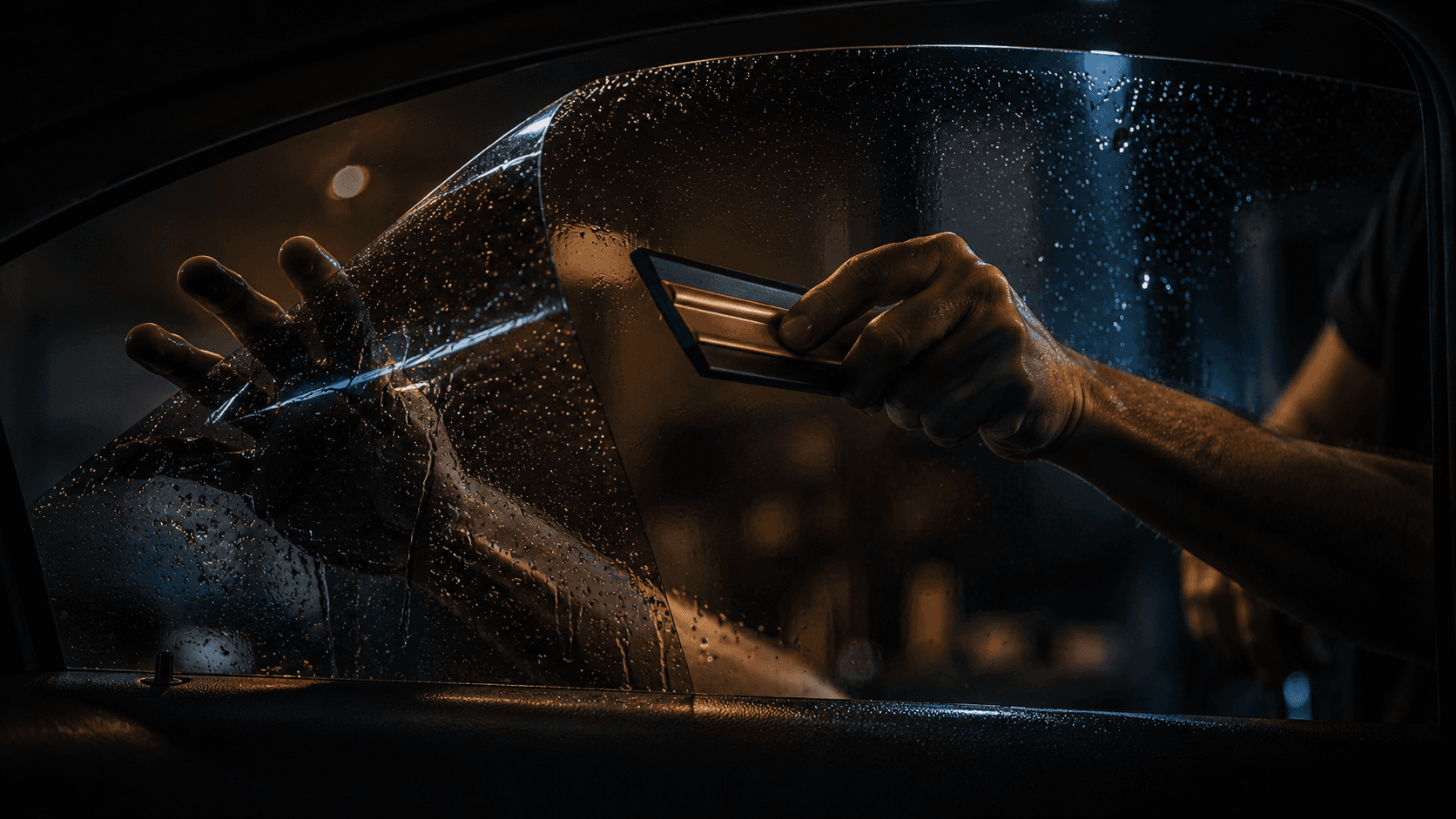
Window tinting
Good window film cuts cabin heat substantially, which reduces air-conditioning load and protects your interior from UV degradation. The important detail in the UAE is the legal limit on how dark you may go — and it differs for private cars and for the windscreen.
Do you need this?
Worth doing on any vehicle used daily in this climate, particularly if it is parked outside. Also worth replacing old film that has gone purple or started bubbling, which is what happens to cheaper dyed films after a few UAE summers.
Signs to look for
- Existing film turning purple or bubbling
- Interior trim and dashboard fading or cracking
- Cabin unbearably hot after parking
- Air conditioning struggling to keep up
What we actually do
Step by step, so you know what you are paying for.
We confirm the film specification and the legal limit that applies to your vehicle and each window.
Glass is cleaned thoroughly — almost every film failure traces back to contamination at fitting.
Film is computer-cut or hand-cut to the exact window shape.
Film is applied and squeegeed to remove all moisture.
Edges are sealed and the vehicle is left to cure.
We tell you how long to leave the windows up while the film cures.
Included in the price
- Film supply and fitting
- Glass preparation
- Compliance with UAE legal tint limits
- 5% VAT
Nothing is added at the counter. If we find something unexpected, we tell you the cost and wait for you to agree before doing it.
Questions we get asked
What is the legal tint limit in the UAE?
UAE law limits how dark window film may be on private vehicles, and the windscreen is restricted separately and much more tightly than the side and rear glass. Limits are enforced at vehicle inspection. We fit within the legal limit and will confirm the current figure before starting work.
Does window tint actually reduce heat?
Quality film does, substantially — but the darkness is not what does it. Heat rejection comes from the film’s infrared-blocking layers, so a good ceramic film that is relatively light can reject far more heat than a cheap dark dyed film that only reduces visible light.
Why does old tint go purple?
Cheap dyed films use organic dyes that break down under sustained UV exposure, shifting the colour toward purple and eventually causing bubbling as the adhesive fails. Metallised and ceramic films do not use those dyes and hold their colour far longer in this climate.